IRON MINES TIMELINE
1854
'Iron Knob' appeared on a grazing lease application.
1861
Abraham Scott took up 56 square miles.
1868
Abraham Scott's holdings were transferred to Sir John Morphett and Sir Samuel Davenport.
1886
Sir Samuel Davenport exhibited specimens of Iron Knob ore at the Colonial and Indian Exhibition in London.
1888
The smelters at Port Pirie were established.
On June 6th, William Jones, a prospector from Broken Hill, applied for a mining lease south of Corunna Station. There were 34 applications.
1890
Permission for the lease was granted.
1899
The Broken Hill Propriety Company Limited (BHP) was granted iron ore leases at Iron Knob in November.
from 1901
The 3' 6" gauge line to Hummock Hill (now Whyalla) was built from Iron Knob
The Iron Knob Township was built for the developing Iron Knob and Iron Monarch Mines.
Once the railcar system had been completed to Hummock Hill, now known as Whyalla, the ore was then carted to port to be shipped across the Spencer Gulf to Port Pirie for smelting.
The rich Iron and Magnetite ore from Iron Knob was allowing the BHP Co. to begin diversifying, just at a time when it seemed that Broken Hill Mines, the Company's main source of income, were beginning to wane.
By the mid 1930s BHP had either begun mining, or pegged leases at, Iron Baron, Iron Queen, Iron Prince, Iron Duke, Iron Knight and Iron Duchess.
1930
A branch from Middleton Junction to Iron Baron was opened.
1941
The blast furnace was opened at Whyalla.
1947
The Iron Baron mine went out of operation.
1958
The Iron Baron mine reopened.
1960's
The full steelworks was completed at Whyalla.
1970's
The Iron Prince and Iron Queen mines were opened.
1990
The Iron Baron line was extended to Iron Duke.
1991
The Iron Baron mine closed.
1998
The Iron Duke line from Middleton Junction was closed.
1998
The last ore was taken from the Iron Monarch mine.
2000
In October 2000, the long products components of BHP Steel's business (which included the Whyalla Steelworks, the downstream market mills and various steel distribution assets including the ownership and operation of the tramway to Iron Knob) were separated from the company and listed on the Australian Stock Exchange as OneSteel Limited.
Rail operations were contracted out to Australian Southern Railroad (ASR) and locomotive maintenance was taken over by Clyde Engineering. Track maintenance was carried out by Transfield.
The Iron Knob mine closed and the population of the town dropped down from 800 to about 150 within a few weeks.
2012
Onesteel changed its name to Arrium.
mid-2012
The Iron Baron mine and railway re-opened.
2012
The Iron Monarch pit was re-opened and ore was once again transported by rail to Whyalla.
2015
The Iron Knob mine reopened.
2016
Arrium went into voluntary administration with debts of more than $2 billion.
NB
The Gupta Family Group ("GFG") Alliance, is owned by members of the Gupta family.
Sanjeev Gupta established Liberty House Group in 1992.
Liberty House Group is an independent company within the GFG Alliance.
2017
Arrium was acquired by Liberty House Group.
2021
The tramway, now owned by Liberty House Group, was operated on its behalf by the rail operator, One Rail Australia
2021 After a five-year gap, trains carrying export iron ore resumed running to Whyalla in South Australia as strong market demand drove spot prices to a record level.
ARRIUM Mining railed the first shipment of iron ore out of Iron Knob since the late 1990s.
2022
One Rail Australia was sold to Aurizon Holdings Limited. The 2000 ASR contract was included in the sale.
NB
Aurizon Holdings Limited is a freight rail transport company formerly named QR National Limited and branded QR National. As of 2015 it was the world's largest rail transporter of coal from mine to port. Formerly a Queensland Government-owned company, it was privatised and floated on the Australian Securities Exchange (ASX) in November 2010.
2022 The Iron Sultan mine was approved and would develop a hybrid pellet feed plant to significantly reduce the price of making steel at the Whyalla blast furnace
The Iron Warrior mine was approved and will produce up to 1.5 million tonnes of export iron ore annually.
2023
On the 3rd of March 2023, Aurizon and Viterra submitted a formal application to the Australian Federal Government for A$220 million in funding to repair and upgrade the Eyre Peninsula Railway lines. The proposal includes re-opening the Port Lincoln-Wudinna and Cummins-Kimba lines, upgrades to the outloading facilities at Viterra’s Lock, Wudinna, Cummins, Kimba and Rudall sites with a target of at least 1.3mt of grain to be hauled by rail per year. Aurizon and Viterra plan to have the network reopened within 12 months if funding is approved

The map has been built with my most grateful thanks to mindat.org
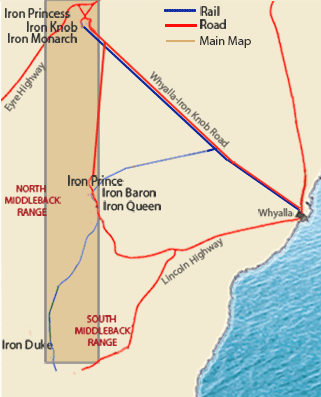
This map appeared in Google Images, sourced from an Arrium report and I have modified it a bit to make geographic sense of the main satellite map, and show the roads and rail tracks. So, thankyou, Arrium. I did write to you but the email bounced.